The Demographic Wave Is Already Here
This isn’t speculation.
It’s mathematics.
Canada’s population is aging faster than any previous generation. By 2036, nearly one-quarter of Canadians will be over the age of 65, making seniors the fastest-growing demographic in the country. As the Baby Boom generation enters their late seventies and eighties, demand for accessible housing, assisted living, retirement residences, and long-term care will accelerate dramatically.
Research consistently shows that housing demand rises significantly after age 75, when accessibility, healthcare, and support services become increasingly important.
Ontario simply doesn’t have enough supply.
Toronto and the GTA Will Feel the Pressure First
No market illustrates this challenge more than Toronto and the Greater Toronto Area.
This region contains Canada’s largest concentration of aging homeowners.
Many have spent decades building lives in their neighbourhoods and have no desire to relocate hundreds of kilometres away. They want to remain close to family, healthcare providers, transit, shopping, and the communities they know.
Unfortunately, these are also the locations where developable land is the scarcest and approvals are the longest.
That disconnect creates one of the largest opportunities in Ontario real estate.
The Housing We Need Doesn’t Exist Yet
When most people hear “senior housing,” they picture retirement homes.
The future is far more diverse.
Ontario needs an entire continuum of housing that includes:
- Independent living communities
- Purpose-built rental housing designed for older adults
- Active adult communities
- Assisted living residences
- Long-term care facilities
- Mixed-use communities integrating healthcare, retail, and residential uses
- Affordable and non-market seniors housing
- Co-housing and shared living models
- Age-friendly condominium developments
The goal isn’t simply providing shelter.
It’s creating communities where residents can age in place safely and independently while maintaining access to healthcare and everyday services.
Ontario Is Already Behind
Ontario’s housing shortage isn’t limited to ownership housing.
The province has experienced decades of underinvestment in affordable rental and non-market housing. Seniors represent a significant proportion of households waiting for rent-geared-to-income housing, with some municipalities reporting that older adults account for nearly half of all applicants.
At the same time, rising construction costs, labour shortages, higher interest rates, and constrained financing continue to slow new development.
Ironically, every project delayed today makes tomorrow’s shortage even worse.
Planning Is the Real Bottleneck
Contrary to popular belief, land isn’t always the biggest obstacle.
Time is.
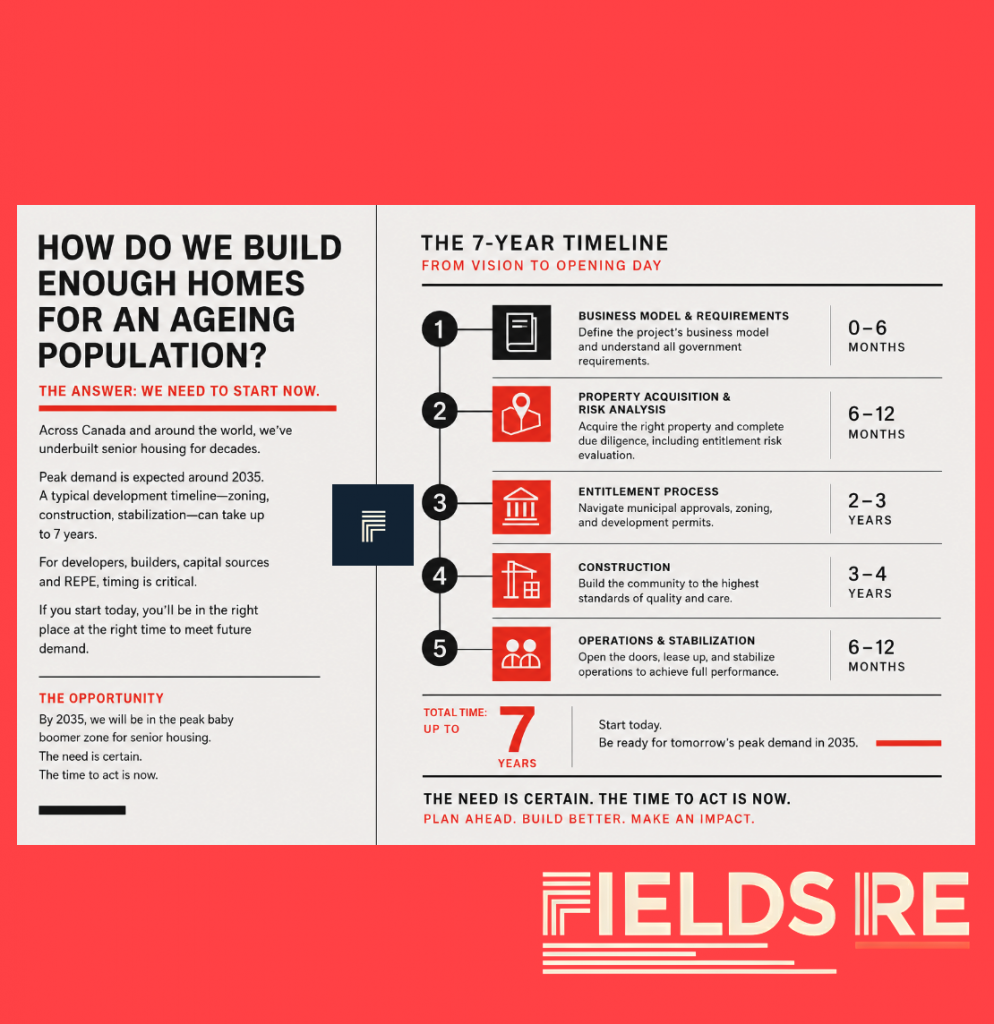
Before construction even begins, projects often require Official Plan conformity, zoning amendments, technical studies, community consultation, environmental reviews, financing approvals, and municipal site plan approval.
For senior housing developments, additional accessibility standards, building code requirements, and service integration further increase project complexity.
The result?
Projects that should take years often take nearly a decade.
Where the Greatest Opportunities Exist
Developers who understand demographic trends will begin acquiring land differently.
Future demand will concentrate around locations offering:
- Higher-order transit
- Major hospitals
- Medical office buildings
- Existing shopping districts
- Walkable urban neighbourhoods
- Community centres
- Parks and recreation
- Mixed-use intensification corridors
Across Toronto and the GTA, underutilized shopping plazas, aging office properties, surplus institutional lands, church properties, and low-density commercial sites could become the next generation of senior-focused communities.
Governments Must Think Beyond Long-Term Care
The solution isn’t simply building more nursing homes.
Research increasingly points toward integrated communities that combine housing, healthcare, recreation, retail, and community support services.
Universal design principles, barrier-free accessibility, adaptable floor plans, and mixed-use planning all reduce dependence on institutional care while allowing seniors to remain independent longer.
Well-planned communities also reduce pressure on hospitals, emergency departments, and long-term care facilities.
Financing Must Change
One of the largest barriers identified throughout the research isn’t demand.
It’s capital.
Developers face significant pre-development costs years before construction begins. The research recommends expanded grant funding, low-interest financing, government-backed lending, portfolio-based financing, and more predictable funding programs to reduce risk and accelerate delivery. Stable long-term financing—not one-time funding announcements—will be essential if Ontario hopes to produce enough seniors housing over the next decade.
The Next Great Development Cycle
Every generation creates a defining real estate opportunity.
The post-war era built suburbs.
The 1990s saw the construction of office towers.
The 2000s transformed Toronto through condominium development.
The next cycle may well be defined by communities built for an aging population.
For developers, municipalities, institutional investors, and landowners, the opportunity isn’t simply to build more housing.
It’s to build the right housing.
Because by the time Ontario realizes how much senior housing it actually needs, the market will already be years behind.